
ZAOSEQ LABS / LANGUAGE & INTERACTION v0.3.0 Research Preview
ZaoSeq Bopomofo
造序注音 · ZaoSeq Technologies
ZaoSeq Bopomofo is a research version of Zhuyin (Bopomofo) character selection that runs in the browser. From the Zhuyin you type, the system produces candidates whose readings are valid, then orders them using corpus statistics and context. v0.3.0 publishes the research core; the live demo below generates candidates with the public v0.3.0 decoder and ranks them with the v0.2 ranking model.
LIVE DEMO
Zhuyin input and candidates
Use the on-screen Zhuyin keyboard, or switch your physical keyboard to English mode and type with the Daqian key positions. Candidates are produced live by the inference service.
Enter Zhuyin with the on-screen keyboard, a physical keyboard or an example.
DECODING PIPELINE
How characters are chosen
- Zhuyin input
- ZaoSeq Decoder
- Valid candidate sequences
- Corpus + Lexicon Ranking
- Fine-tuned Contextual Ranker
- Final output
The model only re-ranks candidates that the ZaoSeq decoder produced and whose readings are valid; it does not freely generate Chinese text. Fine-tuned from Laya Multilingual for contextual candidate ranking.
INPUT TOLERANCE / IN PROGRESS
Tolerance for Zhuyin typos
ZaoSeq Bopomofo is experimenting with combining whole-sentence context and Zhuyin distance to recover the more likely input from a limited set of valid candidates.
When the inference service provides correction information, unconfirmed Zhuyin shows an unobtrusive hint; confirmed text stays under your control.
RELEASE / v0.3.0
v0.3.0 public research core
Adds higher-order character n-grams, Witten–Bell / Kneser–Ney language models, a hybrid model and a decoder that checks Traditional Chinese character forms. Small examples run offline on your own computer.
Publishes Zhuyin parsing, the lexicon, candidate generation, corpus license auditing and the evaluation interface. 260 public component tests pass, along with a per-file allowlist and a secrets scan.
This release adds no new formal benchmark; a formal quality report will follow once the sealed evaluation is complete. Candidates in the live demo come from the decoder published in this release, while the ranking model stays at v0.2 and is not published with this release.
Source on GitHub · v0.3.0 release · Download the public source · Offline guide (Chinese) · Full release report (Chinese) · File verification record
RESEARCH STATUS / v0.2 HISTORICAL RESULTS
TEST-V1 sealed evaluation
The following is the historical v0.2 evaluation, kept for reference. It is not a quality validation of v0.3.0.
The configuration was frozen before the new test set existed, and the formal evaluation was run once. v0.2 added approved everyday corpora and word lists, improving the decoder's candidate coverage and ranking.
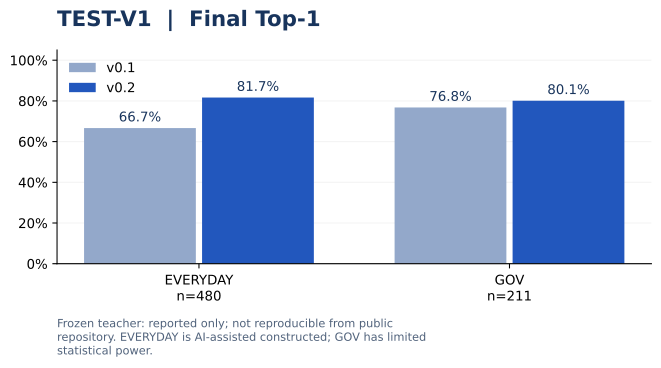
EVERYDAY is 480 sentences built with AI assistance, so its sentence patterns may be more regular than real input; 89 sentences changed from wrong to right and 17 from right to wrong (exact McNemar p = 5.9 × 10⁻¹³). GOV is 211 sentences, with limited statistical power. These are not direct comparisons with commercial input methods.
This is still a Research Preview: there is no formal production runtime validation and no official latency figure, and it is not a Windows or macOS system input method. Zhuyin typo tolerance is off by default.
Read the full test method and technical notesPRIVACY
How data is handled
No account is needed. Input is used only for the current inference. It is not stored and is not used as model training data.
With the public service, preceding text and Zhuyin are sent to this site's API only when you submit. With the local service, the browser connects only to 127.0.0.1 on the same device, and the local bridge forwards only to the model API on that device. Composition you have not submitted stays on the page. This site has no analytics on input content, and its proxy and inference code do not log input content. Infrastructure may record connection information; please do not enter sensitive data.
DATA & LICENSE
Data and licenses
Reading data comes from the CNS11643 Chinese Standard Interchange Code master character set, sourced from the Ministry of Digital Affairs and used under the Open Government Data License Taiwan 1.0. Laya Multilingual is a third-party Apache-2.0 model, and the mmBERT encoder it contains is MIT licensed.
The v0.2 research corpus also uses Tatoeba and Mozilla Common Voice 27.0 zh-TW. The permitted use and license of each dataset are listed in the public export record; the code's Apache-2.0 license does not apply to them. Government data sources · Everyday corpus sources.
Data and third-party licensesRun ZaoSeq Bopomofo yourself
The public repository provides Zhuyin parsing, the decoder, the lexicon, corpus tools and tests. The v0.3.0 release provides source code and offline examples. It does not include the private teacher checkpoint, the inference service or deployment data, so a download cannot directly reproduce the contextual ranking of the public demo. If you have prepared a compatible API, choose the local service above. The public demo shows only real API results; it never shows simulated results when the service is not ready.
View the v0.3.0 GitHub release