
v0.2 RESEARCH PREVIEW / TECHNICAL NOTES
Research status and data sources
ZaoSeq Bopomofo first uses its own decoder to produce candidates whose readings are valid, then ranks them with a contextual model. v0.2 added statistics from government data and approved everyday corpora, plus derived word lists; the contextual model reuses a frozen teacher and does not freely generate Chinese characters. The live demo generates candidates with the public v0.3.0 decoder and keeps the v0.2 contextual model.
The new sealed test, TEST-V1
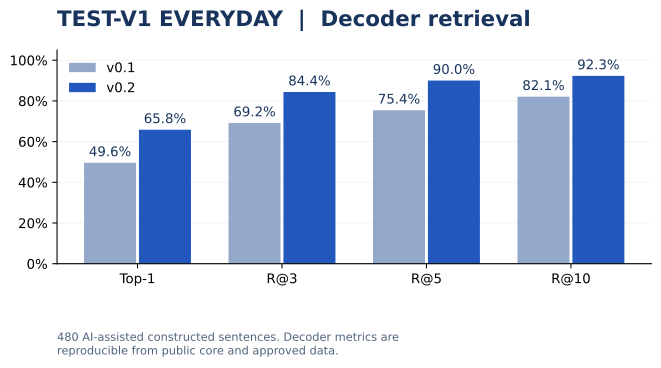
The v0.2 configuration and selection rules were fixed on DEV first; a new TEST-V1 was then built and the formal evaluation was run once. The table shows whole-sentence top choice and decoder metrics; written variants are handled according to the test rules. This is an internal ZaoSeq evaluation. It is not a direct comparison with commercial input methods and does not represent the accuracy of the live demo.
| Metric | v0.1 | v0.2 |
|---|---|---|
| EVERYDAY final Top-1 · 480 sentences | 66.7% | 81.7% |
| EVERYDAY decoder Top-1 | 49.6% | 65.8% |
| EVERYDAY decoder R@3 | 69.2% | 84.4% |
| EVERYDAY decoder R@5 | 75.4% | 90.0% |
| EVERYDAY decoder R@10 | 82.1% | 92.3% |
| GOV final Top-1 · 211 sentences | 76.8% | 80.1% |
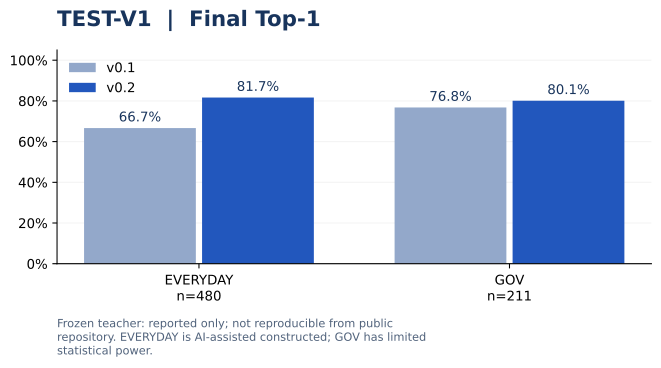
On EVERYDAY final, 89 sentences changed from wrong to right and 17 from right to wrong; exact McNemar p = 5.9 × 10⁻¹³. EVERYDAY is 480 sentences built with AI assistance, so its sentence patterns may be more regular than real user input. GOV has only 211 sentences, so its statistical power is limited. The full test rules, results and verdict are in the public test report and the formal JSON.
What can be reproduced, and limits
The public repository contains the decoder, lexicon, corpus tools and evaluation framework. It does not contain the private frozen teacher checkpoint, weights, inference service or deployment. Final Top-1 is reported only and cannot be reproduced from the public repository alone. v0.2 has no formal production runtime validation, so no official latency figure is published; this is a Research Preview, not a Windows or macOS system input method.
Data and licenses
CNS11643 reading data and the government corpora in use are licensed under the terms of their respective sources. The v0.2 everyday corpus includes Tatoeba and Mozilla Common Voice 27.0 zh-TW; only Common Voice sentence ids and sentence text are used, not speaker data. Permitted uses, licenses and attribution for each source follow the public export record, and the original corpora are not attached to the release. Laya Multilingual is a third-party Apache-2.0 model, and the mmBERT encoder it contains is MIT licensed.
Code license · NOTICE · Third-party licenses · Export record · Government data sources · Everyday corpus sources